 S, Little Lady, and I braved the near 100 degree heat and finally made it to the Citadel. We signed up for a tour with a group from the Embassy because we were unsure how to get there and had a hard time finding directions. We really need to get a GPS that has maps of the Middle East. So we get there, meet up with our tour guide and begin the adventure that is the Citadel. Now I will do my best to tell you about it. The Citadel is located on top of a Jabal (Hill) surrounded by Wadis (valleys) that then have more Jabals on the other side. This location has been has been highly sought after throughout the centuries as it is an easily defensible position with an amazing view of the wadi. So the Citadel has a long long history. It began as early as the
Neolithic period (new stone age) and became more of a strong hold in the
bronze age 1800 BC. Though the ruins that are visible today are
from is the Roman and early Islamic periods. In the Bible it is said
that King David even captured the city in 10th century BC. (WOW that is a
long history)
S, Little Lady, and I braved the near 100 degree heat and finally made it to the Citadel. We signed up for a tour with a group from the Embassy because we were unsure how to get there and had a hard time finding directions. We really need to get a GPS that has maps of the Middle East. So we get there, meet up with our tour guide and begin the adventure that is the Citadel. Now I will do my best to tell you about it. The Citadel is located on top of a Jabal (Hill) surrounded by Wadis (valleys) that then have more Jabals on the other side. This location has been has been highly sought after throughout the centuries as it is an easily defensible position with an amazing view of the wadi. So the Citadel has a long long history. It began as early as the
Neolithic period (new stone age) and became more of a strong hold in the
bronze age 1800 BC. Though the ruins that are visible today are
from is the Roman and early Islamic periods. In the Bible it is said
that King David even captured the city in 10th century BC. (WOW that is a
long history)
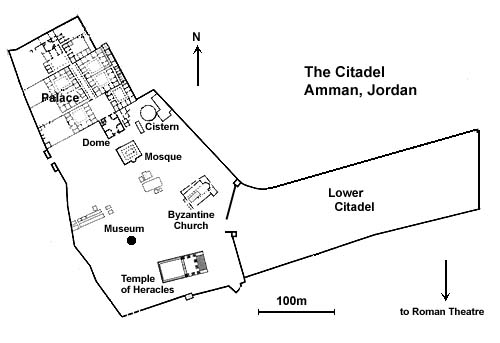
Here is a map of the Citadel so you can see how this is all laid out as we go along. Our tour begins in the lower Citadel at the entrance ( A great place to start right?)
 | |||
| View from the entrance of the Citadel. |


This is the statue and it is currently on display in the museum
So from the entrance you walk up a long walk through the lower Citadel. As you walk you come to a site that is a gravesite with unknown occupants but they are from a fairly recent time frame. The main thing you see and can see from a great distance is the Temple of Hercules or the Great Temple of Amman.


Many of the different inhabitants of this area have been resourceful in their building habits. Parts of the columns and temple have been relocated and used in building other parts of the Citadel during different periods of history.

If it wasn't cool enough to see the temple ruins, there is even a bit of the statue that is thought to be Hercules left on the site. It is his fingers and elbow. The statue is thought to be approx 40 ft high when it was complete. You can even make out the fingernails and knuckles.
Here I am getting ahead of myself. Once you stare in awe at the remains of the temple from the front, you continue walking up the path towards the rear of the temple and you pass by the evidence of habitation during the Bronze age. It is a small cave that has been unearthed during one of the digs at the site.


I must say that it is an impressive cave. It has a wall blocking the opening of the cave to create a smaller entrance and even a bit of stairs stepping down into it.
Now we just jumped from the temple which was 161-166 AD to 1800 BC with the cave and if you continue up the path you are greeted by the newer (compared to everything else here) museum. So this place gets a bit confusing with what century you are currently viewing. Located in the museum are artifacts of the history of Amman and Jordan. The Dead Sea Scrolls used to be housed here but they have recently been relocated to a different museum that is soon to open. There are fossils, mosaics, statutes, bones, tombs, and even jewelry and pottery from all different ages located in the museum. Here are a few pictures of artifacts.
 |
A small child's skeleton. It is laying on the broken pieces of pottery that it was found in. Children were often buried in pottery and placed under the living room floor in an effort to keep the family together

I believe this is another burial chest. It may have contained remains or it could have been filled with items that were thought to go on with the dead to the after life.

Here are some tombs that were uncovered. The white parts are pieces that were missing when it was discovered and so they made replacements.
Ok so I apparently only uploaded items that were dealing with death. But there were lots of other things like plates and statues and things. You will just have to come to Jordan to see what you missed.
When you finish in the museum you come down the stairs and view the rear of the temple. Everywhere you look you will find ruins of something. Here is a creepy face that has somehow managed to survive the test of time.


Though you cannot see it from this angle the door is actually still attached.
Maybe S will come back through here and edit what I cannot remember about things.
We continue on and look over some amazing overlooks and then on to the Mosque. There are only some pilars left of the mosque now and a small section of one wall has been restored.
 |
| The section of wall |
After you view the remains of the mosque you can then head to the palace. The dome has been restored with wood and here is one of the places to see pieces of the temple that have been reused throughout history. The main part of the palace that is standing today is the court. This is the area where the governor or king would have met with people wishing to speak with him. This was one place with an amazing breeze and we could have stayed in the cool breeze for the rest of the day.

The entrance to the court

The recently replaced roof.

One of the alcoves in the court. Each has carving in the door and smaller alcoves around them. About here is where I tuned out for a bit. I sat in the entrance way with Little Lady, enjoyed the breeze and wished we were able to bring water with us. However since we traveled during Ramadan we were unable to drink water unless we were on the bus. (we chose to respect the custom of fasting and not drink in public). Sorry maybe after future trips I will learn what I missed about the court.
Once you exit through the back of the court you are in the ruins of the palace. I have no idea how many rooms there are to this palace but the place is massive. What we can see now is only one floor, the basement if you will. It is thought that it had possibly 3 stories or more to it.

One doorway looking into a room

An above view of palace ruins looking at the back of the court.
After we walked through and around the palace we walked to the cistern. Strangely it is thought to be an open topped cistern. They had a gutter system that would collect rain water (which is very precious here) and guide it to the cistern where it would be stored. I guess they were not very concerned with evaporation.

After you have viewed the cistern you continue on the path back towards the temple. When you get close to the temple again you come to the ruin of a Byzantine basilica which is thought to be from 6 or 7 AD.

This view of the basilica is from the back. You can see toward the top of the picture the columns that would have lined the aisle way of the basilica and the arch is part of a reconstructed wall of the apse.
We walk along past the Temple of Hercules one last time

If this left you wanting more information here are some sites you can check out and that I referenced in reviewing some of my dates of objects.
http://www.kinghussein.gov.jo/tourism1.html
http://www.visit360.net/en/africa-middle-east/jordan/amman/amman-citadel-360/101-amman-citadel-360
http://www.art-and-archaeology.com/jordan/amman/citadel.html


